
Marine Electronics
ICS helped a global manufacturer of premium outdoor recreation products modernize its marine electronics platforms by combining Qt Quick, embedded Linux expertise and a pragmatic migration strategy.

Modernizing the User Experience for Industry-Leading Fishing Electronics
For more than a decade, ICS has partnered with a leading manufacturer of premium outdoor recreation products to bring advanced marine electronics to anglers around the world. In an earlier collaboration, ICS provided Qt expertise to help develop the company’s flagship electronics and chartplotter platform known for its powerful sonar, mapping and navigation capabilities.
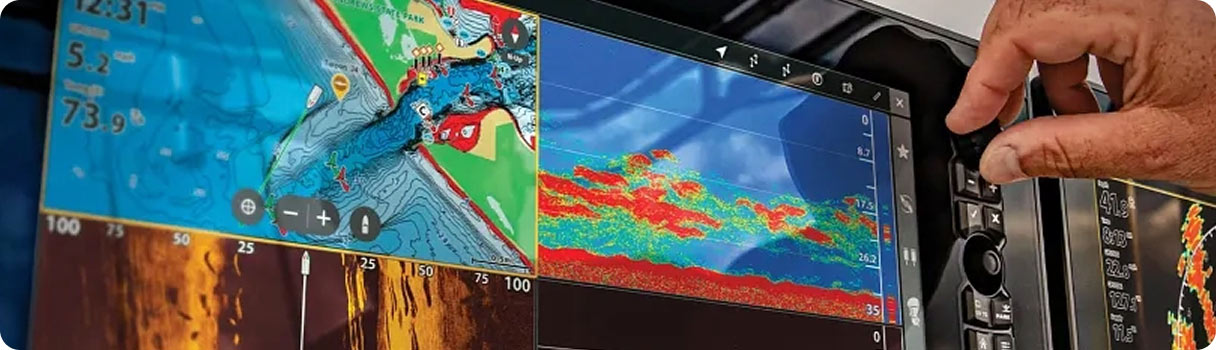
Building on that success, the outdoor equipment company re-engaged with ICS to support a major user interface modernization initiative. The goal was to create a new, highly intuitive touchscreen experience for its next-generation series of marine electronics while also preserving existing software investments by refreshing its popular existing product line.
The outdoor equipment company had developed a new user experience in Figma, but needed guidance on the most effective way to implement the design within an established embedded software platform. With limited in-house experience building large-scale Qt Quick applications using C++ and QML, the company turned to ICS for architecture guidance, embedded Linux expertise and implementation support.
THE CHALLENGE
Modernize a Legacy Platform Without Disruption
The project involved much more than simply creating a new interface as the existing fish finder software represented years of development. It was built primarily using Qt Widgets, with some newer functionality already implemented in QML. Replacing the UI wholesale would have introduced significant risk, cost and disruption to ongoing product development.
Additionally, the software platform itself was highly sophisticated. The fish finder runs multiple applications simultaneously — including the user interface, sonar processing, mapping, networking and other subsystems — which communicate through a database-driven architecture. Any new UI implementation would need to integrate seamlessly with these existing components while maintaining performance and reliability on embedded hardware.
Speaking of hardware, the platform also presented challenges. The outdoor equipment company wanted to enable wireless capabilities on products built around a legacy platform that included an aging wireless chipset. The chipset had changed ownership multiple times over the years and had ultimately been discontinued.
Despite the hardware being present in shipped products, the company had never been able to fully utilize its Wi-Fi and Bluetooth capabilities. ICS needed a solution that could modernize the user experience without disrupting existing functionality, while also unlocking dormant hardware capabilities.
ICS transformed a complex UI modernization effort into an award-winning product experience, creating a reusable software foundation that extends across product lines, reduces future development effort and accelerates ongoing innovation.
THE SOLUTION
A Phased Migration Enabling Wireless Connectivity
Collaborating with the outdoor equipment company’s own engineers, ICS developed a migration strategy that balanced modernization with long-term maintainability. Rather than replacing the entire UI framework, we recommended a hybrid architecture that leveraged Qt Quick and QML for new user experiences while preserving some portions of the existing Qt Widgets application. By designing a flexible, reusable UI architecture, ICS helped the company extend the value of its investment beyond a single product launch.
Using QQuickWidget, we embedded modern QML scenes within the existing architecture, enabling a phased transition that minimized risk and rework. And we established scalable development patterns that the customer’s engineers could readily extend and maintain internally.
Additionally, we addressed the tricky wireless subsystem challenge within the constraints of an aging Yocto Linux environment. We sourced and integrated the latest available drivers for the discontinued chipset, created new Yocto recipes for the wireless stack, developed patches for BlueZ Bluetooth components, and updated the HMI software to leverage the new capabilities.
We also added support for Wi-Fi, Bluetooth Classic and Bluetooth Low Energy so the company could enable wireless connectivity on existing hardware platforms without costly redesigns.
THE RESULT
An Award-Winning Launch
The outdoor equipment company successfully launched its next-generation marine electronics product series, which features a modernized user experience that simplifies operation while providing access to advanced sonar, navigation and mapping capabilities.
The new platform received strong market recognition, with industry reviewers praising its intuitive interface, customization capabilities and performance improvements. It also earned a Best in Category award for Marine Electronics at one of the fishing industry's premier trade events, recognizing its innovation and user experience.